SMM December 31:
Key Points: China's first national standard for automotive solid-state batteries, "Electric Vehicles—Solid-State Battery—Part 1: Terminology and Classification," was released for public comment on December 30, 2025. The standard clearly categorizes batteries into three types: liquid, hybrid liquid-solid, and solid-state, eliminating the term "semi-solid-state." It sets a mass loss rate of ≤0.5% as the core criterion for defining solid-state batteries. This move aims to unify industry standards, end conceptual confusion, and marks a step toward standardized industrial development.
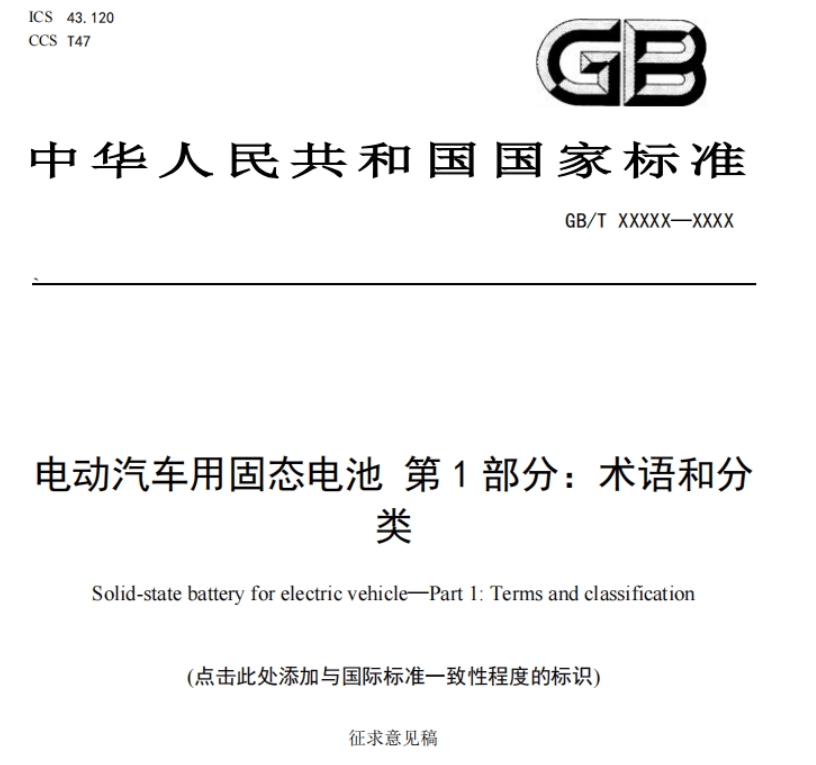
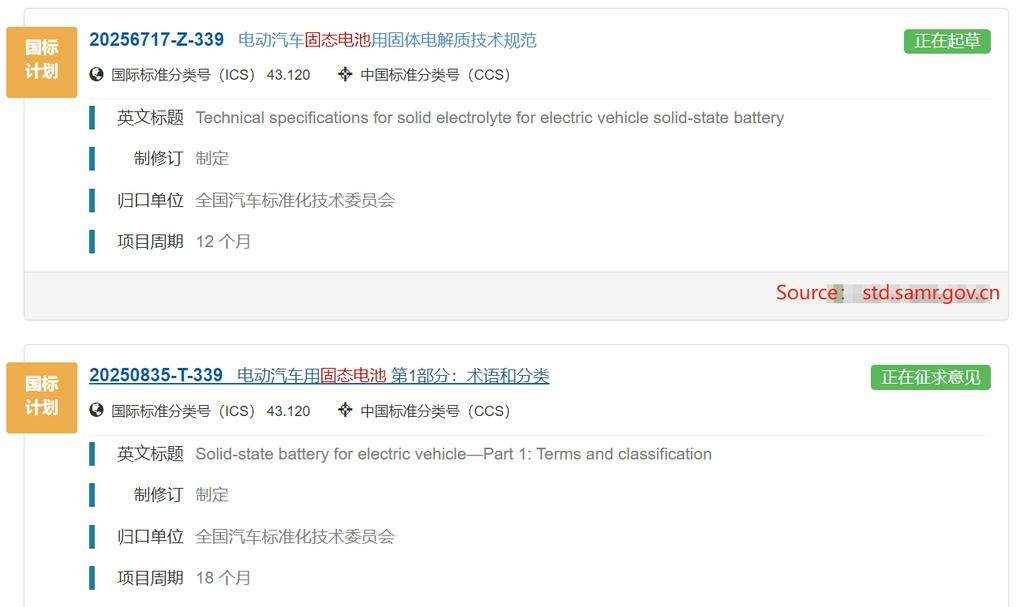
On December 30, 2025, the National Automotive Standardization Technical Committee solicited public comments on "Electric Vehicles—Solid-State Battery—Part 1: Terminology and Classification." As China's first national standard for automotive solid-state batteries, this initiative is regarded as a key milestone in transitioning this cutting-edge technology from the laboratory to industrial collaboration. It aims to resolve market conceptual ambiguities and lay the foundation for standardized industry development. The concurrent "Technical Specification for Solid Electrolytes Used in Electric Vehicle Solid-State Batteries" is currently in the drafting stage.
I. Core of the Standard: Unified Classification and Stringent Technical Thresholds
The draft focuses on establishing a unified technical terminology system and setting clear quantitative criteria for defining "solid-state batteries."
Clear Three-Type Classification, Eliminating "Semi-Solid-State": Based on the method of ion transport within the cell, the standard categorizes batteries into liquid batteries, hybrid liquid-solid batteries, and solid-state batteries. This means the previously commonly used term "semi-solid-state battery" is not included in the national standard system, and related products will be classified as "hybrid liquid-solid batteries."
Establishment of Key Criterion: The standard sets a strict core quantitative indicator for defining "solid-state batteries"—the mass loss rate. It stipulates that the mass loss rate (mass loss of electrolytes and other components under specific test conditions) for solid-state batteries should not exceed 0.5%. This threshold is stricter than the group standard "All-Solid-State Battery Determination Method" released in May 2025 (mass loss rate <1%). The basis for this requirement is consideration of potential minor decomposition of solid electrolyte materials, and industry validation tests show that compliant products have mass loss rates below 0.5%.
Multi-Dimensional Classification System: The standard further classifies solid-state batteries along three dimensions:
By Electrolyte Type: Sulphide-, oxide-, polymer-, halide-, and composite electrolyte-based solid-state batteries.
By Conducting Ions: Solid-state lithium-ion batteries, solid-state sodium-ion batteries, etc.
By Application Field: High-energy type, high-power type, etc.
II. Standard System Planning: Building a Comprehensive Industrial Framework
The "Terminology and Classification" draft is only the first step in a series of national standards. According to the plan, the "Electric Vehicles—Solid-State Battery" series is divided into four parts:
Part 1: Terminology and Classification (current draft)
Part 2: Performance Specifications
Part 3: Safety Specifications
Part 4: Life Specifications
Additionally, the supporting "Technical Specification for Solid Electrolytes Used in Electric Vehicle Solid-State Batteries" has entered the drafting stage, indicating that standardization efforts are extending to core materials.
The introduction of standards means the industry now has relatively unified and standardized guidelines for enterprises and practitioners to follow, aiming to end conceptual confusion, unify technical standards, facilitate industry chain collaboration, and seize international rule-making influence.
According to SMM forecasts, all-solid-state battery shipments will reach 13.5 GWh by 2028, while semi-solid-state battery shipments will reach 160 GWh. Global lithium-ion battery demand is projected to reach approximately 2,800 GWh by 2030, with the EV sector's lithium-ion battery demand showing a CAGR of around 11% from 2024 to 2030, ESS lithium-ion battery demand at a CAGR of about 27%, and consumer electronics lithium battery demand at a CAGR of roughly 10%. Global solid-state battery penetration is estimated at about 0.1% in 2025, with all-solid-state battery penetration expected to reach around 4% by 2030, and global solid-state battery penetration potentially approaching 10% by 2035.
**Note:** For further details or inquiries regarding solid-state battery development, please contact:
Phone: 021-20707860 (or WeChat: 13585549799)
Contact: Chaoxing Yang. Thank you!